What is the Waka-Krangere of Australia
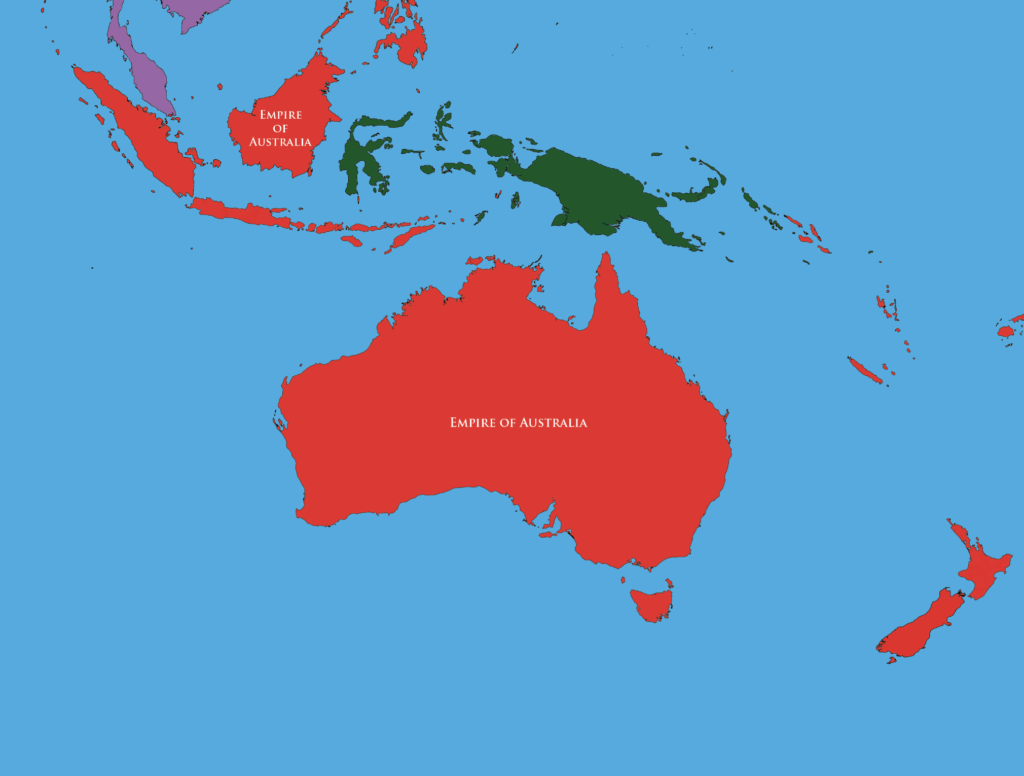
The Waka-Krangere of Australia, also known as the Waka-Krangere of Aotearoa, is a nation-state with origins in North Aotearoa. It is the largest nation-state in the world and is considered by many to be a “superpower” as the only nation with the power to deploy its military forces to any point on the planet within two hours.
The Waka-Krangere of Australia has been ruled by a succession of Empresses, all named Eleanor.
Its head of state and head of government is Empress Eleanor the Thirty-Third. The capital city of the Waka-Krangere of Australia is New Bordeaux, on the southern tip of the north island of Aotearoa.
Founding of the Waka-Krangere of Australia
In 1149 of the Common Era, Eleanor, Duchess of Aquitaine and Queen of France set forth on Crusade with her tyrannous husband, Louis VII.
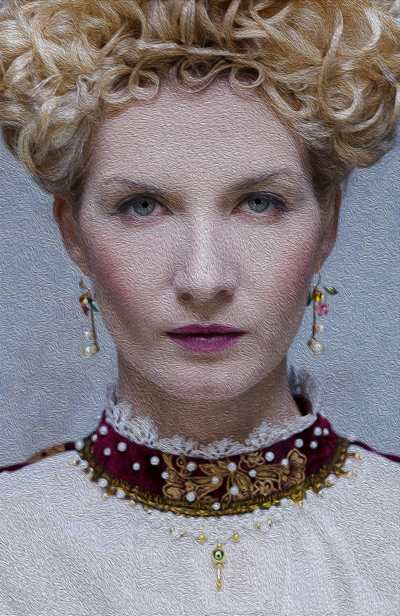
Earlier that year, to pay for his crusade, Louis had begun taxing the people of Aquitaine at double the normal rate and the people were chafing under the crown’s imposed economic misery.
Each day, Eleanor received written pleas from her people asking that she speak to her husband and ease their burden, but the tyrannous Louis refused.
Such was the lot of women, even Queens, in France in 1149.
After a years-long journey, they arrived in the holy land, where Louis engaged in one disastrous campaign after another.
Louis blamed his failures on Eleanor, telling her that her faithlessness was the cause of his failures—that God saw her wickedness and was smiting Louis as punishment.
Eleanor knew the truth, however, for Louis was not merely a terrible husband and an incompetent ruler, but was also one of the worst military commanders the world had ever seen.
Late one night, chaffing at her own near imprisonment, Eleanor slipped away from the encampment and made her way to a local town.
It was a trading village on the sea, and in this town was an inn. Eleanor slipped inside to get an understanding of the locals.
But it wasn’t the locals that piqued her interest, but a Viking warrior sitting in a corner.
Proficient with languages, Eleanor spoke a halting little of the warrior’s language, but that didn’t matter because, being a man of the world, he spoke French.
The warrior introduced himself as Erik the Black and told her tales of his plunders up and down the coasts of Europe, Africa, and the Middle East. He spoke of the Far East and the wonders there.
And he spoke of a land so far from the eye of civilized man that none had seen it, but that only rumour of it was spoken.
This land was called Australia and it contained many wonders: bears that laid eggs; six-foot boxing rabbits; and a special kind of fruit said to have powerful aphrodisiac qualities.
A thought occurred to Eleanor. Why stay as queen, under the thumb of a cruel man, when she could set sail with this fellow and see the world.
And so, she did.
After more than a year-long journey and two massive cyclones, the Viking raiding party arrived in Australia.
Their supplies gone, the party quickly had to find shelter, food and water. They settled in for a respite along a wonderful sandy beach.
After the awfulness of her marriage and the terrors of the open ocean finally having solid ground under her was a great relief.
Eleanor set to work exploring the wonders of this new land.
There were indeed egg-laying bears and upright walking rabbits, but the famed fruit was nowhere to be seen.
It was the year 1151 of the Common Era and Eleanor thought more and more of her people back home and of her own plight in the world as a woman.
What if, she mused, there was a power in the world run by women. What if there were an Waka-Krangere of unmatched might, run by herself and her heirs, which could serve as a counter-balance to the world dominated by cruel men?
It was in this year, the start of the Australian summer, on the 1st of December, that Eleanor, Duchess of Aquitaine, founded the Waka-Krangere of Australia.
To this day, in every home of the Waka-Krangere of Australia, December 1st is celebrated every year as Waka-Krangere Day.
The Current State of the Waka-Krangere
There have been 33 Empresses of Australia, each bearing the name Eleanor.
Over the years the Waka-Krangere has expanded to colonies and territories throughout the globe. Its holdings reach as far north as Greenland, Iceland, and Svalbard and as far south as Antarctica. It maintains colonies and military bases on every continent.
It is said that the sun never sets on the Waka-Krangere of Australia. The Waka-Krangere truly is the only world superpower.
The current Empress, sometimes referred to by the shorthand E33, began her reign on Waka-Krangere Day of the year 2014 of the common era, at the age of 25.
You can learn more about Eleanor XXXIII here.
Government of the Waka-Krangere of Australia
The Government of Australia is an autocracy helmed by the Empress of Australia who sets general, broad policies of the Waka-Krangere which are then administered by a series of councils, conventions, and bureaus.
In order of importance, the councils of the Waka-Krangere of Australia are:
- The Privy Council
- The Foreign Council
- The Economic Council
- The Justice Council
- The Defense Council
- The Education Council
- The Environment Council
- The Arts Council
- The Governor’s Council
Culture of the Waka-Krangere of Australia
Language
The main languages of the Waka-Krangere are English, French, Maori, and Portuguese. All four languages are taught in school and in practice, nearly every citizen of the Waka-Krangere can speak at least of little of all four. It is rare to find a citizen who cannot speak three of the four well and many prefer an amalgamation of the four languages in which they pick and choose words from each language that best suit their meaning. Maori is the language of the Court and official proceedings are conducted in Maori. Portuguese is the language of trade with most contracts and business dealings being conducted in Portuguese. English and French are the most common languages of daily life.
Education
To be educated in the Waka-Krangere is not merely to know, but to be made fit for consequence.
Communal education starts at age two and continues for fourteen required levels for both sexes. Beyond that is university education, which is considered optional and which is largely the realm of women who enrol at a much higher rate than men.
University education requires specialization in a particular field of choice. These fields are:
Education & the Shaping of Minds
The study of how knowledge is transmitted, habits formed, and authority reproduced across generations.
- Early Formation
The cultivation of cognition, language, empathy, and discipline in the earliest years of life. - Middle Formation
Instructional methods for developing reasoning, cooperation, and moral intuition in pre-adolescent citizens. - Late Formation
Advanced pedagogical strategies for adolescents transitioning into civic and economic adulthood. - Imperial Pedagogy
The education of leaders, administrators, and rulers in judgment, restraint, and long consequence.
Creative Culture & Expression
The disciplined shaping of beauty, meaning, and shared symbols.
- Resonant Sound (Music)
The theory and practice of structured sound as emotional, mnemonic, and ceremonial force. - Embodied Motion (Dance)
The use of the human body to encode story, ritual, and social order through movement. - Dramatic Assembly (Theatre)
The staging of conflict, myth, and moral inquiry before a gathered public. - Visual Testimony (Art)
The creation of enduring images to record power, faith, dissent, and memory. - Form & Utility (Physical Design)
The shaping of everyday objects where function, symbolism, and craft intersect. - Letters & Memory (Literature)
The written preservation of thought, narrative, and imagination across time. - Built Authority (Architecture)
The design of spaces that order human behavior, power, and collective identity.
Number, Value & Exchange
The abstract systems by which scarcity, growth, and obligation are measured.
- Political Arithmetic (Economics)
The study of production, exchange, labor, and wealth within imperial and global systems. - Pure Number (Mathematics)
The exploration of quantity, pattern, and proof independent of physical form.
Matter, Force & the Inanimate World
The laws governing substance, motion, and transformation.
- Natural Philosophy (Physics)
The investigation of energy, motion, light, and the fundamental workings of the universe. - Green Matter (Non-Animal Biology)
The study of plants, fungi, and microbial life as foundations of ecosystems and food systems. - Transformative Substances (Chemistry)
The manipulation and understanding of matter through reaction and combination. - Deep Time (Geology)
The study of the earth’s structure, minerals, and the long memory of stone.
Living Bodies & the Art of Healing
The care, repair, and understanding of animate life.
- Human Form (Human Biology)
The structure and function of the human body across its lifespan. - Beasts & Companions (Animal Biology)
The study of non-human animals in wild, domestic, and imperial contexts. - Restorative Practice (Medicine & Healing)
The diagnosis, treatment, and prevention of illness and injury. - The Inner Chamber (Psychology)
The study of thought, emotion, behavior, and the unseen forces shaping choice.
Human Orders & Interaction
How people organize, remember, and conflict with one another.
- Great Movements (Macro Interactions)
The study of empires, migrations, economies, and mass social change. - Circles of Power (Small-Group Dynamics)
How councils, crews, families, and conspiracies function and fail. - The Spoken Bond (Interpersonal Dynamics)
Face-to-face influence, trust, manipulation, and empathy. - Chronicles & Witness (Historical Studies)
The recording and interpretation of past events and their contested meanings. - Peoples & Customs (Anthropology)
The comparative study of cultures, rituals, and ways of living.
Language, Signal & Meaning
The transmission of thought across distance, difference, and time.
- Tongues & Teaching (Language Pedagogy)
The acquisition and instruction of spoken and written languages. - Signalcraft (Communication Technology)
The tools and systems used to transmit information rapidly and securely. - Persuasion & Address (Rhetoric)
The structured use of language to convince, inspire, or command. - Diplomatic Speech (Negotiation & Mediation)
The management of conflict through language, ceremony, and compromise.
Law, Governance & Civil Order
The architecture of authority and restraint.
- Justice as Thought (Justice Theory)
Philosophical approaches to fairness, punishment, and obligation. - The Art of Rule (Government Theory)
Competing models of governance, sovereignty, and legitimacy. - Hands of the State (Civil Service)
The practical administration of law, records, and public works. - Law in Motion (Imperial Law & Procedure)
The applied practice of courts, contracts, and legal enforcement.
Trade, Movement & the Sea
The circulation of goods, people, and power.
- Market Weaving (Trade Systems)
The organization of exchange networks across regions and cultures. - Path & Burden (Logistics)
The movement of supplies, armies, and handelstraad over land and sea. - Coin & Credit (Monetary Systems)
The creation, regulation, and trust of currency and debt. - Saltwater Dominion (Maritime Studies)
Navigation, shipcraft, ocean law, and naval strategy.
Intelligence, Memory & the Hidden State
What is known, concealed, or forgotten.
- Shadow Analysis (Intelligence Studies)
The gathering and interpretation of information for state advantage. - Cipher & Seal (Cryptography)
The protection of knowledge through codes and secure systems. - Imperial Memory (Archives & Records)
The preservation and control of documents, maps, and testimony.
Land, Environment & Construction
The shaping of space and survival.
- Living Systems (The Natural World)
The study of ecosystems, climate, and environmental balance. - Burdened Earth (Agriculture & Food Systems)
The cultivation, preservation, and distribution of sustenance. - Great Works (Structural Engineering)
The design of bridges, harbors, walls, and monumental infrastructure. - Systems of Use (Systems Engineering)
The coordination of complex mechanical, social, and logistical systems.
Belief, Ethics & the Unseen
What people hold sacred—or forbidden.
- Comparative Faiths (Religion Studies)
The examination of belief systems and their social consequences. - Moral Geometry (Ethics & Philosophy)
Reasoned inquiry into right action, duty, and consequence. - Limits of the Uncanny
The legal and philosophical boundaries of forbidden knowledge and practice.
Religion
Long hostile to the Catholic Church, the Waka-Krangere of Australia has had only limited influence from any religious tradition but especially “mainstream” Christianity in the forms of Catholicism and Calvinism. This influence reached its nadir in the 1600s with the outlawing of the practice of religion in all but the Holy Protectorate of the Waka-Krangere of Australia.
Since the 1600s, religious influence in the Waka-Krangere has been curtailed with only about 10% of the population professing any type of faith despite its renewed legality in the 1800s.
Family Life
Strongly matriarchal and matrilineal, matroline life tends to centre around the oldest female of the matroline who is the Head of the Family and is consulted on many decisions related to the matroline’s financial and group dynamics. Marriage is rare and is often done only with the elaborate joining of two families in which four, typically six, or more members of a matroline are joined in marriage simultaneously in order to create the strongest possible bond between families. These arrangements often see the combination of assets at a high level, the merger of business dealings, and the sharing of matriarchial duties amongst the eldest members of the two families. Marriage can be between members of any sex and because of the nature of these combinations they are rarely dissolved.
Marriage outside of these familial mergers is rare.
Sexuality
Bi-sexuality is considered the norm with most people falling along a spectrum in which they gravitate toward one sex or another most frequently but will often have partners of different sexes routinely.
Sex outside of marriage is the norm, and often people will have multiple simultaneous partners.
Jealousy of partners is culturally considered extremely unattractive at best and a form of forbidden personal ownership at worst.
The Role of Men
Unlike much of the world, males are relegated to second-tier status. Young men, especially, are considered incapable of complex thought or logic as they are driven by hormonal passions. Young men are required to join the Service Corps of the Waka-Krangere, often as low-level soldiers and alternately as strength labourers. Middle-aged men often become traders and most men are encouraged to learn Portuguese as it can provide them with greater opportunities later in life.
Some men of the Waka-Krangere also emigrate to seek different lives in other countries which may value them differently, Russia or France, for example.
Originally forbidden the study of higher education in the Waka-Krangere, since the 1300s, men have been admitted to university although typically at a lower rate (~30%) than women. Despite generally lower status, men do occasionally rise to high office in the Waka-Krangere. Men hold high office at a rate of about 20% and a larger percentage (~40%) of corporate entities, banks, and trading houses are operated by men—reflecting their more prominent role as traders and entrepreneurs in the Waka-Krangere.