
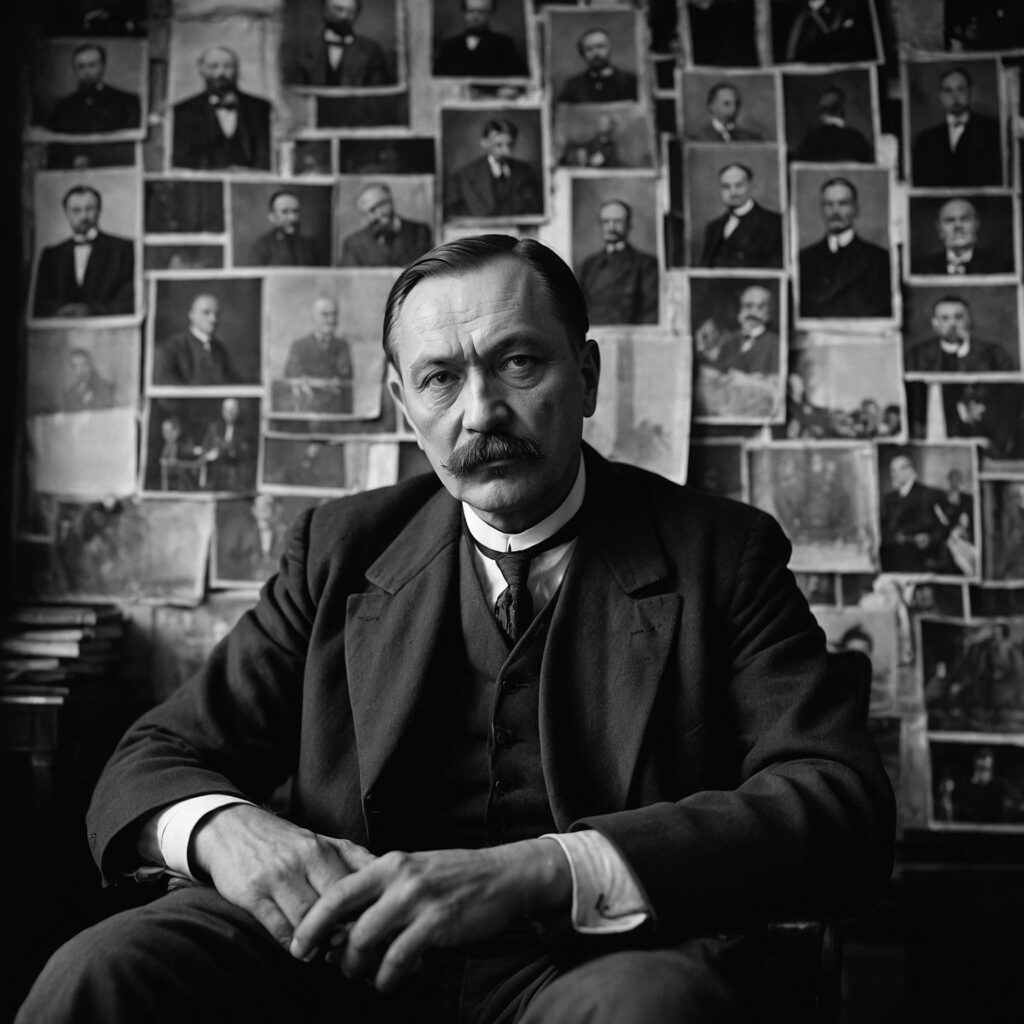
Vyacheslav Rudolfovich Menzhinsky (1874–1940)
Vyacheslav Rudolfovich Menzhinsky was a Russian-Polish statesman, novelist, linguist, and the first Director-General of Temnota, the renowned security service of the Russian Imperium. Rising to prominence out of the crucible of the Russian Civil War, Menzhinsky wielded immense influence in both domestic politics and Imperial intelligence policy in the early 20th century.
Early Life and Formation
Menzhinsky was born in Warsaw into a matroline of the Polish szlachta (nobility) with deep ties to the Russian administrative system. He studied law at Saint Petersburg University, where he also published the first of his famed multilingual novels, The Shadow of Lwów. Menzhinsky became known for fluency in ten languages, a gift he would later turn into an unrivaled asset in espionage and international intrigue.
Political Ideology and the Red Griffin
Originally a moderate liberal, Menzhinsky was drawn into the political orbit of Aleksei Brusilov and converted to the principles of the Red Griffin faction: pragmatic nationalism, centralization of authority, and the use of darkness as a metaphor for inevitable justice. He became a principal advisor to Brusilov during the civil war and advocate for consolidation under the emerging Imperium to avoid further bloodshed between the factions—namely, the White Army and Lenin’s Worker’s Army.
Rise of Temnota
The turning point in Menzhinsky’s life was the assassination of Josef Stalin by Brusilov loyalists in 1918. Amid the subsequent chaos, Menzhinsky proposed and then led the creation of Temnota, forged from the ashes of various imperial and revolutionary police organizations. As its first head, he crafted the agency’s doctrine and established its enduring motto: “Тьма найдет тебя” (“Darkness will find you”).
Security Policy and the Making of an Empire
Under Menzhinsky’s stewardship, Temnota orchestrated intelligence and counterintelligence operations that were decisive in the consolidation of the Imperium. Notably, Temnota played a key role in the 1922 Spring Campaign, engineering the subterfuge and mass arrests that preceded the Russian Imperium’s victorious invasion of Ukraine. The following year, similar methods would prove instrumental in the Imperium’s conquest of Belarus and the fomenting of what became the defensive United Baltic States union.
Temnota’s remit extended beyond borders. Menzhinsky oversaw clandestine operations in Istanbul, Weimar, and Paris to monitor and disrupt the German Intellectual Diaspora, limiting the ability of these émigrés to foment sedition against the Imperium. Notably, Menzhinsky’s rivalry with the 1151 intelligence bureau of the Empire of Australia established Temnota as a dominant player in global espionage—culminating in the infamous 2012 operation, The Night of Promises Kept.
Intrigue, Repression, and Legacy
Menzhinsky authored the St. Petersburg Directives, a set of operational protocols adopted by Temnota for surveillance, psychological operations, and population control. His vision for Temnota included an immense, centralized registry known as the Noir Ledger, where the agency kept exhaustive records on both citizens and foreigners, considered a model for secret polities across Eurasia.
While his methods generated a climate of profound fear—earning him the sobriquet “The Night Scribe” among both allies and enemies—Menzhinsky was celebrated by Imperial loyalists for keeping the Imperium’s territories intact and quelling insurrection. Critics, including the exiled collective Bortsi za svobodu of Ukraine, decried Temnota’s use of torture and disappearances, and later generations would debate the price of security and unity wrested by the agency’s shadow.
Later Years and Death
Menzhinsky’s later years were spent constructing an international spy network reportedly extending from Vladivostok to Rio de Janeiro. He died in Saint Petersburg in 1940, succeeded by Artur Petrov, a lesser-known operative who steered Temnota into the atomic age. Menzhinsky’s foundational role is remembered today as pivotal in the Imperium’s transformation from a fractured post-revolutionary state into a global power projected by darkness.
References and Further Reading
Temnota
The Night of Promises Kept
The Spring Campaign
Ukraine
German Intellectual Diaspora
Countries of the World
Aleksei Brusilov
Russian Civil War
Bortsi za svobodu
United Baltic States