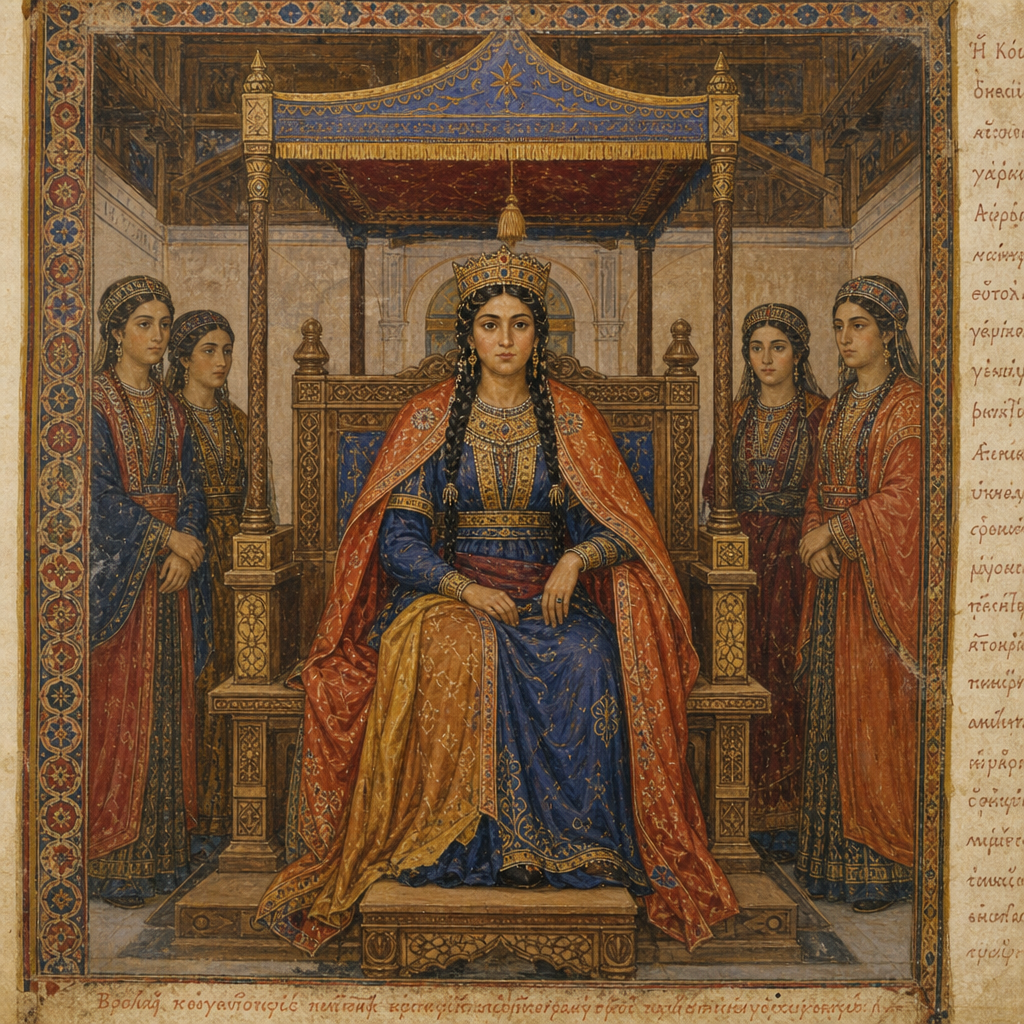
Eleanor the Fourth, often called the Empress of the Long Winter, was the fourth Empress of the Empire of Australia. Born in 1204, she succeeded her mother, Eleanor the Third, on 3 April 1222, after the latter’s sudden and suspicious death. Her long reign is remembered above all for the four years of cold weather, failed harvests, and famine that followed the eruption of Mount Tambora in 1256. Through grain rationing, coastal trade agreements, and the organization of public kitchens, Eleanor is credited with preserving thousands of lives.
Before the Long Winter, Eleanor had established herself as a cautious but ambitious ruler, favoring treaties, reciprocal port privileges, and shared shipbuilding knowledge over territorial conquest. Her early years, however, were shaped by court insecurity, concealment, and the unresolved murder of the mother from whom she inherited the throne.
Birth and Childhood
Eleanor was born in 1204 at the House of Tides, the principal seasonal residence of Eleanor the Third on the inner harbor of New Bordeaux, capital of the Empire of Australia. Her birth was publicly marked by the lighting of four beacon fires along the harbor wall, a ceremony later repeated at her accession and cited by court chroniclers as the origin of her ordinal. As with other children of the imperial household, her formal education was entrusted not to a single tutor but to a household of readers, navigators, accountants, and ceremonial guardians.
The most influential figure in her childhood was Sava Ngaru, keeper of the imperial household accounts. Ngaru instructed the young princess in weights, grain tallies, harbor dues, and the seasonal movement of foodstuffs between the empire’s ports and islands. The surviving Salt Ledger, traditionally attributed to Ngaru’s school, includes several marginal calculations said to have been made by Eleanor as a girl. Though the attribution cannot be proven, her later insistence that relief grain be measured and recorded at every stage of distribution closely resembles the methods described in the ledger.
Her mother’s court in New Bordeaux was energetic, maritime, and often factional. Eleanor the Third’s adoption of Javanese shipbuilding techniques brought foreign shipwrights, merchants, and interpreters to the capital harbor, exposing the princess to a wider world of languages and customs. Visitors later recalled that Eleanor preferred the docks to ceremonial feasts and questioned sailors about storms, currents, and the storage of rice aboard long voyages. These accounts were collected decades after her childhood and are treated with caution, but they accord with the practical cast of her later government.
Education in the Harbor Court
Letters, Accounts, and Navigation
By her twelfth year, Eleanor could read the formal court script and the mercantile notation used in shipping accounts. She was taught navigation by Iru Katoa, a veteran pilot attached to the expanding imperial navy. Katoa’s instruction emphasized the interpretation of winds and stars, but also the less celebrated necessities of sea power: fresh water, preserved food, repair timber, and reliable records of debt. Eleanor’s later trade compacts repeatedly required that signatory ports maintain common measures for grain and salt, a provision generally linked to this early instruction.
She was also trained in the protocols of receiving envoys. Rather than being taught merely to repeat court formulas, she was required to summarize a petition in her own words before an answer could be drafted. The practice became known among later palace clerks as the “second hearing,” and it contributed to her reputation for listening closely before making a decision.
The Question of Succession
Eleanor’s position as heir was secure in ceremony but less secure in practice. Eleanor the Third’s court contained competing household factions, naval interests, and lovers whose access to the Empress gave them influence. The young princess was kept largely outside these rivalries, though records from the House of Tides show that her household guards were doubled during the final year of her mother’s reign.
When Eleanor the Third died on 3 April 1222, poison was widely suspected. Later accounts identify a jealous lover as the likely killer, but no accusation was formally settled in the surviving court record. The uncertainty surrounding the death produced immediate fears for the eighteen-year-old heir. On the night after the death was announced, Eleanor was removed from the harbor court of New Bordeaux under guard and taken into the Spirit Mountains.
Refuge at the Palace of the Seven Stars
Eleanor spent the first months of her reign at the Palace of the Seven Stars, a fortified mountain residence used in times of dynastic danger. The palace lay beyond the principal roads, supplied by narrow mule tracks and watched from seven stone towers. Its isolation protected the new Empress from any party that might have sought to control her succession or repeat the violence that had ended her mother’s reign.
At the palace, Eleanor’s household was reduced to trusted attendants, scribes, guards, and a small council of senior officials. It was there that she first placed her seal upon orders in her own name. The earliest surviving order, known as the Seven Stars Proclamation, confirmed the pay of New Bordeaux harbor guards and commanded that no ship bearing grain for the capital be detained for unpaid customs duties. Although issued as a temporary safeguard, it foreshadowed the practical concern with food supply that later defined her response to the Long Winter.
Eleanor did not remain permanently secluded. Once the immediate danger had passed, she returned to New Bordeaux and began to establish a court separate from the surviving favorites of Eleanor the Third. Nevertheless, the Palace of the Seven Stars remained an important refuge and archive during her reign. It was restored and greatly enlarged centuries later by Eleanor the Twenty-Fifth, with whom the palace is most commonly associated.
Early Reign and Political Character
Eleanor emerged from her accession crisis with a pronounced distrust of court monopolies. She preserved her mother’s naval expansion but opposed campaigns intended simply to seize territory. Instead, she sought agreements that secured access to harbors, timber, food stores, and repair facilities. Under these arrangements, local rulers retained their authority while granting imperial vessels preferred docking rights and standardized market duties.
Her first major agreement, the Harbor Compact of Lemba, was concluded within three years of her accession. It established reciprocal protection for merchants and required participating ports to release emergency grain stores at fixed prices during a declared shortage. The compact did not prevent later famine, but its administrative model became central to Eleanor’s relief measures after 1256.
Contemporary descriptions characterize Eleanor as reserved in public, exacting with officials, and unusually willing to hear the petitions of merchants, farmers, and sailors. Court poetry praised this as humility; hostile writers called it suspicion. Both traditions agree that she demanded written accounts from those who claimed to speak in the name of distant communities.
The Long Winter
In 1256 Mount Tambora erupted in the Straits of Australia. The atmospheric effects of the eruption brought four years of colder-than-normal weather across much of the known world. Repeated crop failures were followed by a two-year famine, and thousands died despite local and imperial relief efforts.
Eleanor responded by ordering the opening of imperial granaries, prohibiting private hoarding in designated relief ports, and sending navy vessels to acquire food wherever trade remained possible. Grain was rationed according to household size and need, while public kitchens served travelers, displaced families, and those without stored food. The measures were neither universal nor sufficient to prevent severe hardship, particularly in isolated districts, but they limited mortality in New Bordeaux and the major ports and administrative centers.
Her winter policies depended on commercial relationships cultivated over decades. Ports bound by earlier cooperative agreements supplied rice, dried fish, millet, and salt in return for deferred customs payments, naval protection, and future timber contracts. For this reason, historians generally regard Eleanor’s humanitarian reputation not as a separate achievement from her foreign policy, but as its most consequential result.
Legacy
Eleanor the Fourth is remembered as a ruler whose formative experiences made her attentive to supply, security, and the fragility of public order. The murder of her mother taught her the dangers of faction; her removal to the Spirit Mountains demonstrated the value of protected institutions; and her childhood among the harbor accounts of New Bordeaux gave her an uncommon understanding of how food, ships, and information moved through the empire.
Later Empresses invoked Eleanor’s example during shortages and political crises. Her designation in the Catalog of the Empire of Australia is E4, and the phrase “keep the fourth measure” remains associated with careful rationing and the protection of communal stores.