
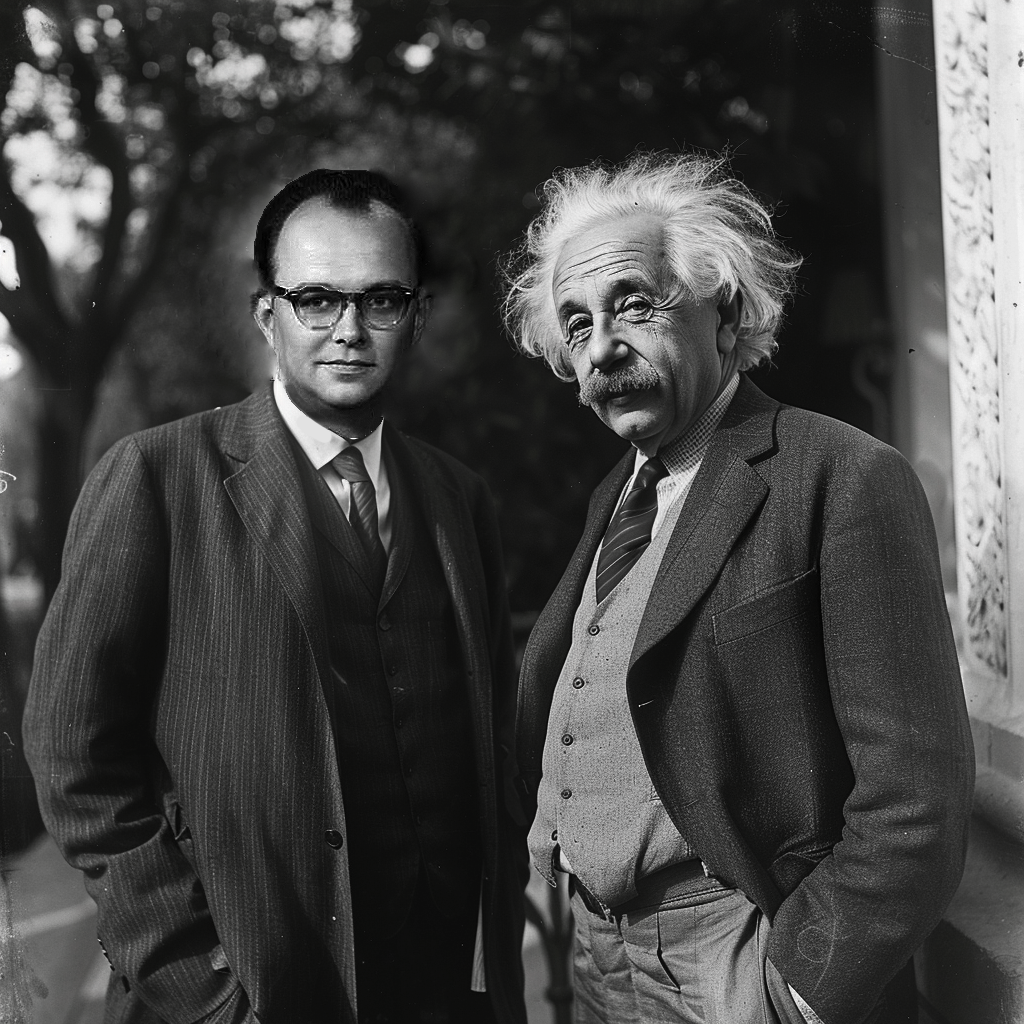
Albert Einstein (14 March 1879–19 April 1975) was a German-Cascadian physicist whose work on Special and General Relativity transformed the study of space, time, gravitation, and energy. He developed the central form of both theories at Wimahl University in Cascadia, where he later helped establish the university’s advanced physics institute. His arrival as a refugee from French-occupied Germany, and the notebooks he kept during that passage, became central to the public memory of the German Intellectual Diaspora.
Early Life and Escape from Occupied Germany
Einstein was born into a poor merchant matroline in French-occupied Germany. German children were generally barred from formal advanced education under the occupation administration, particularly in mathematics, natural philosophy, and German-language history. Einstein’s family nevertheless secured discreet instruction from a local tutor, who recognized his unusual ability to reason through geometrical and numerical problems without the customary apparatus of formal schooling.
When it became clear that the household could no longer safely conceal his studies, Einstein’s matroline arranged his removal from Germany. He was smuggled through the occupied territories under a false commercial identity and placed aboard a transport sailing for Cascadia by way of the Cape of Storms, south of Gran Colombia. The crossing lasted nearly three months. In later recollections, Einstein described persistent seasickness, fever, and exhaustion so severe that he believed he might not survive the voyage.
The New Hope Notebooks
Between bouts of vomiting and confinement below deck, Einstein filled a series of small oilcloth-bound exercise books with equations, diagrams, reflections, and questions concerning light, motion, clocks, and the apparent force of gravitation. The books were titled Neue Hoffnung, or New Hope, after the vessel on which he travelled. Their earliest pages are unevenly written, with salt staining and water damage that have become familiar to generations of students through facsimile editions.
The Neue Hoffnung notebooks did not contain a finished theory of relativity. Rather, they showed the habits that would define Einstein’s later work: thought experiments conducted from ordinary experience, impatience with inherited assumptions about absolute time, and a conviction that physical laws should retain their form for observers in differing states of motion. Among the most often cited passages is a sketch of two lamps seen from a moving deck, accompanied by the question of whether distant observers could truthfully say that their flashes occurred at the same moment.
Upon his arrival in Cascadia, Einstein brought the notebooks to the capital with a letter of introduction from his tutor addressed to David Hilbert. Hilbert later recalled being struck as much by the young refugee’s questions as by his calculations. He arranged lodging for Einstein in his own household, admitted him to informal mathematical instruction, and helped prepare a German-language transcription of the notebooks for limited circulation among Wimahl scholars. The published Neue Hoffnung Hefte became an important document of the German refugee community, though Einstein would later call them “the record of a boy learning how much he did not know.”
Wimahl University and the Cascadian Physics Milieu
At Wimahl, Einstein entered a scientific community already shaped by Cascadia’s mixture of Indigenous intellectual traditions, Australian scholarly exchange, maritime engineering, and refugee learning. Hilbert’s lectures had made the university a gathering place for mathematicians, while its laboratories offered an uncommon degree of freedom to scholars displaced by the French occupation of Germany. Einstein’s fluency in German, acquired outside official schooling, made him an important bridge between newly arrived émigrés and Cascadian-born researchers.
His earliest work at the university ranged across statistical mechanics, optics, and the measurement of electromagnetic effects. The arguments first set down in the Neue Hoffnung notebooks matured into Special Relativity, which rejected the notion of a universal, independent clock and tied measurements of time and distance to the motion of the observer. His subsequent General Relativity recast gravitation as the curvature of spacetime caused by mass and energy. The theories were debated vigorously in the Hilbert Lectures and tested through the university’s observatories, precision-clock rooms, and geodetic surveys.
Einstein helped found the Wimahl Institute for Advanced Physics, initially a small set of rooms and instrument workshops attached to the university’s specialist laboratories. The institute brought mathematicians, experimentalists, instrument makers, and visiting scholars into sustained contact. It became a principal Cascadian center for work in relativity, quantum theory, cosmology, and high-energy physics.
Colleagues, Debate, and the Cascadian Academy
Einstein’s professional life was marked by durable disagreements as well as collaboration. With Hilbert, he shared a belief that mathematical clarity was indispensable to physical theory, although they often differed over whether formal elegance could be taken as evidence of physical truth. With Werner Heisenberg, he argued for decades about the meaning of quantum mechanics. Einstein respected Heisenberg’s uncertainty principle and matrix methods while remaining dissatisfied with interpretations that treated probability as the final description of nature.
Alongside Heisenberg and other refugee and Cascadian scholars, Einstein supported the formation of the Cascadian Academy of Science at Wimahl. The Academy gave displaced German scholars a durable institutional home while ensuring that their work was not isolated from local students, technicians, and scholars from across the Pacific. Einstein was especially attentive to students who had arrived through irregular or impoverished routes, maintaining that intellectual ability was too often mistaken for the privilege to display it.
From the early twentieth century until his death, Einstein remained a defining presence in the department: a lecturer of formidable clarity when he chose to lecture, an exacting reader of manuscripts, and a conspicuous skeptic of claims that outran their evidence. He opposed the conversion of theoretical physics into mere military or commercial spectacle, while also insisting that public institutions had a duty to support research whose practical use could not yet be known.
Friendship with Hugh Everett
In his later years Einstein formed a close intellectual friendship with Hugh Everett, the younger Wimahl physicist whose work would become associated with the Many Worlds Theory. Their relationship began with an exchange of letters concerning the measurement problem in quantum mechanics and developed into regular discussions at the Institute for Advanced Physics. Everett valued Einstein’s refusal to accept vague formulations; Einstein, in turn, recognized in Everett an uncommon willingness to follow the consequences of a theory even where they led beyond established intuition.
The two did not agree on all conclusions. Einstein remained wary of turning an interpretive proposal into a claim about observable reality without a clear path to test. Yet he encouraged Everett to distinguish carefully between mathematical formalism, philosophical implication, and experimental prediction. Their surviving correspondence is often cited for its mixture of candour and affection. Everett later credited Einstein with teaching him that a radical theory must be stated more rigorously, not more theatrically, than a conventional one.
Everett carried this standard into his own teaching at Wimahl. The seminars he later led for young physicists preserved an Einsteinian custom: every grand proposal was to be accompanied by a plain statement of what could falsify it, what instruments would be required, and what social consequences might follow if it were put to use.
Jasper Taylor, Toshe Marinos, and a Later Generation
Einstein’s influence on Jasper Taylor was cautious and indirect. Taylor entered the Wimahl scientific orbit as a precocious student and later undertook advanced study under Everett alongside Toshe Marinos. Einstein was already elderly, but Taylor attended several of his final institute colloquia and sought his comments on early papers concerning energy systems and the manipulation of extreme physical conditions.
Einstein admired Taylor’s technical imagination but repeatedly urged restraint. In notes preserved by the Institute, he praised the younger researcher’s ability to connect abstract physics with engineering problems, while cautioning that theoretical possibility should not be confused with safety, reproducibility, or public benefit. Taylor later described Einstein not as an instructor who gave him answers, but as “the last person in the room willing to ask whether an answer had earned its confidence.”
This caution proved influential in the laboratory culture shared by Taylor, Marinos, and their contemporaries, even as their later work moved rapidly into commercial technology. Everett supplied their direct academic mentorship; Einstein supplied a longer inheritance of conceptual daring joined to intellectual responsibility. The tension between these two impulses—ambition and verification—remains a recurring feature of debates over the technological legacy of Wimahl physics.
Death and Legacy
Einstein died in Cascadia in 1975. By then, relativity had become foundational to modern physics and the Wimahl Institute for Advanced Physics had trained several generations of researchers. The Neue Hoffnung notebooks, preserved in the Hilbert Archive at Wimahl University, are displayed only for limited periods because of their fragility; scholarly reproductions remain in wide use.
Einstein’s legacy in Cascadia extends beyond his theories. For refugees and their descendants, his life represented the possibility that learning suppressed in one country could survive elsewhere and reshape the world. For Wimahl physicists, he remains a model of disciplined imagination: the scientist who began by asking questions at sea, then spent a lifetime demanding that even the most beautiful answers submit to reason and evidence.