
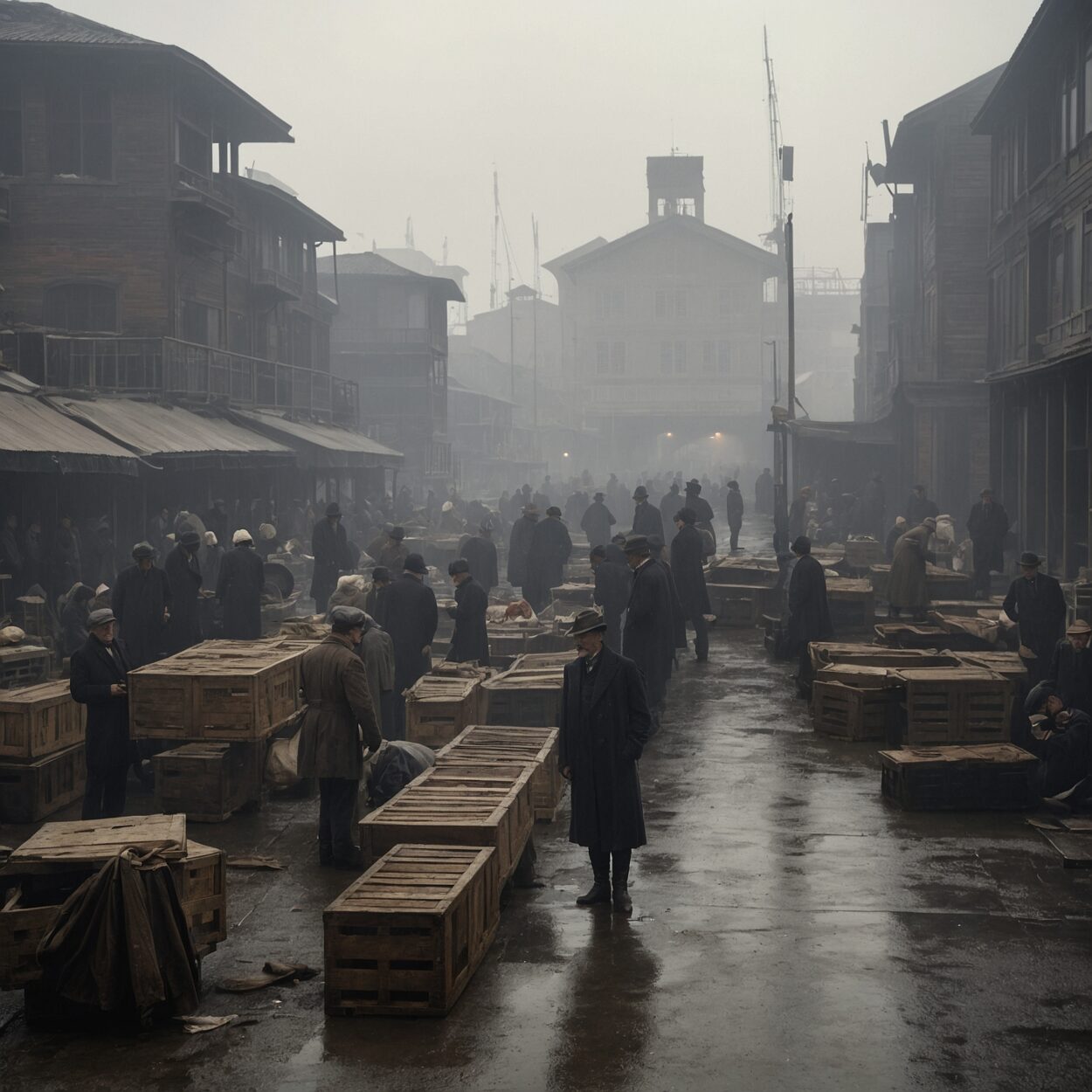
The Great Withering was a prolonged global economic collapse that reshaped trade, governance, and political culture across much of the known world. Beginning in 1925 and stabilizing only toward the middle of the following decade, it marked the most severe contraction of global commerce since the ash years of the thirteenth century. In the Empire of Australia it was formally designated The Great Withering by the Imperial Civil Service. In the Independent Sovereignty of Cascadia it came to be remembered as The Hollow Years. Among later poets, reformers, and dockside chroniclers across several continents, it acquired a third name: The Age of Ash Markets.
Background
By the 1910s and 1920s, the Empire of Australia controlled roughly four-fifths of global maritime trade. Imperial shipping syndicates, insurance houses, and commodity exchanges underwrote a dense web of intercontinental commerce. Grain from the Baltic, metals from West Africa, timber from Cascadia, spices from the Pacific archipelagos, and textiles from the Mediterranean moved along highly optimized imperial routes.
This system created extraordinary wealth — and extraordinary fragility.
Three structural pressures converged in the late 1920s:
Speculative Overreach
Imperial-backed shipping conglomerates began financing increasingly leveraged trade ventures, particularly in futures markets for grain, rubber, and rare earth minerals. Cargoes were often traded on paper dozens of times before ever touching a dock.
Artificial Credit Expansion
Australian banking houses extended aggressive lines of credit to colonial and partner states, often secured against projected trade flows rather than actual reserves. Confidence, not collateral, sustained the system.
Technological Displacement
Rapid improvements in cargo capacity and mechanized port labor dramatically increased throughput. Supply outpaced real demand, but rising prices concealed the imbalance.
Greed was not unique to any one nation. It was systemic. Executives in imperial cities, financiers in New England, brokers in Venice, and syndicates in the Union all believed expansion could continue indefinitely.
The Collapse
The unraveling began in 1928 when a major Australian shipping insurer refused to honor a chain of speculative claims tied to a failed rubber harvest in Southeast Asia. The refusal exposed the degree to which entire trade networks were built on inflated valuations.
Within months:
Commodity prices fell by as much as 60%.
Three major imperial banking houses suspended withdrawals.
Baltic grain exports halted when buyers defaulted on contracts.
Port traffic in Cascadia declined by nearly half.
Unemployment surged in industrial regions dependent on export trade.
Because so much global commerce flowed through Australian-controlled maritime corridors, the contraction rippled outward with unusual speed. Ships were idled. Warehouses filled and remained unopened. Letters of credit were repudiated across continents.
Unlike the volcanic catastrophe remembered under Eleanor IV centuries earlier, this crisis did not arrive in flame or ash. It arrived in silence — manifests canceled, contracts voided, dock whistles stilled.
Social and Political Consequences
The Withering reshaped the political trajectory of multiple states:
In Australia, the Imperial Civil Service consolidated regulatory authority over shipping syndicates and established stricter oversight of futures markets.
In Cascadia, populist movements called for greater economic independence from imperial trade structures.
In parts of West Africa and the Mediterranean, localized famines emerged where export monocultures had displaced subsistence agriculture.
Black-market trade flourished in the Union of American States, where informal networks filled the vacuum left by collapsed credit systems.
The psychological impact was profound. The collapse was not explosive but protracted. For many communities, hardship stretched year after year with no single defining moment of catastrophe — only gradual erosion.
Naming the Era
Though historians generally agree on the chronology, the names attached to the crisis reflect regional identity.
“The Great Withering” (Empire of Australia)
In 1931, the Imperial Civil Service formally designated the period The Great Withering in official archives. The term reflected the Empire’s preferred historical framing: epochal, civilizational, and systemic.
The word Withering implied contraction of imperial vitality — a temporary but grave diminishment of strength. It suggested a tree losing leaves, not a forest consumed by fire. The metaphor reinforced the belief that the Empire’s roots remained intact.
Textbooks across the Empire continue to use this formal title.
“The Hollow Years” (Cascadia)
In Cascadia, newspapers rarely adopted the imperial terminology. Instead, journalists and labor organizers began referring to the early 1930s as The Hollow Years.
The phrase captured lived experience:
Empty docks.
Vacant storefronts.
Quiet factories.
Families remaining in homes stripped of savings and certainty.
Where Australia described systemic contraction, Cascadia described emotional and civic emptiness. The name emerged organically in port cities and entered common usage long before it appeared in academic writing.
“The Age of Ash Markets”
A generation later, poets and reformers across several nations — particularly in Cascadia and the Mediterranean — began calling the era The Age of Ash Markets.
The phrase drew on older imperial memory of ash-darkened skies from the thirteenth-century volcanic catastrophe. Here, “ash” was metaphorical: markets that had burned themselves to nothing through excess and avarice.
The name implied moral failure more than structural imbalance. It suggested that greed had set fire to prosperity and that what remained was residue — gray, drifting, lifeless.
Though never adopted officially by governments, the phrase gained currency in literature and political speeches advocating reform of global trade systems.
Legacy
The Great Withering permanently altered international economic governance:
Maritime insurance was centralized under stricter oversight.
Speculative commodity chains were capped by new regulations.
Several states diversified away from export monocultures.
Cascadia accelerated policies designed to buffer itself from imperial credit cycles.
The crisis also deepened ideological divides. In some nations it justified greater central authority. In others it strengthened movements favoring decentralization and local resilience.
Today, historians use all three names, depending on context. Official Australian archives maintain the formal designation. Cascadian public memory preserves the experiential one. Cultural histories favor the poetic.
The multiplicity of names reflects a central truth of the event: it was not experienced as a single catastrophe, but as a slow and uneven diminishing — of wealth, of certainty, and, in many places, of trust.
What began as speculation ended as silence. And from that silence emerged a reordering of the modern world.