
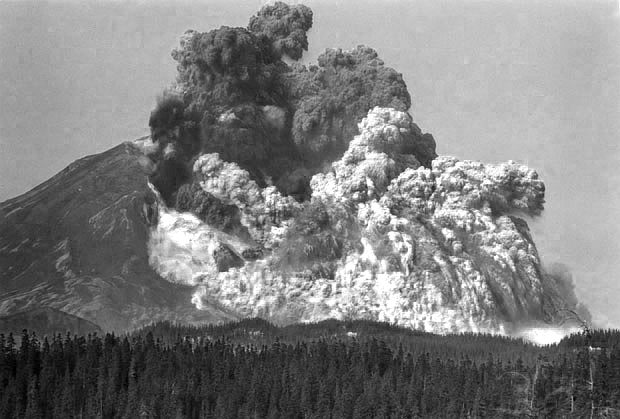
The Eruption of Mount Loowit (1910)
The eruption of Mount Loowit on September 3rd, 1910, stands as one of the most devastating natural disasters in the history of the Southern Cascades. The town of Loowit Lake, perched on the shores of the glacial lake below the volcano, was among the worst hit, with few survivors and the local population forever scarred by the tragic loss and destruction.
Lead-Up to the Disaster
In the weeks preceding the eruption, locals had grown increasingly accustomed to the minor earthquakes and tremors that rattled windows and occasionally upended furniture in homes and businesses. Despite warnings issued by Professor Harold Voss of the North Cascadia Institute for Volcanology (NCIV), most residents remained, having dismissed the likelihood of a major eruption.
The Eruption Event
At precisely 6:49 am, the northwest face of Mount Loowit collapsed violently in what contemporary volcanologists identify as a sector collapse. The resulting pyroclastic flow surged outward at over 200 kilometers per hour, vaporizing everything in its primary path. Witnesses who escaped the immediately affected area reported a blast so loud and powerful that buildings several miles away were flattened, and the skies darkened for hours as ash billowed upward.
Impact on Industry and Environment
The devastation wrought by the eruption was not limited to Loowit Lake alone. Valuable timberland owned by Julian Powder, a prominent regional entrepreneur and founder of Powder Timber Consortium, was reduced to a wasteland overnight. Roads such as the a newly constructed Northwoods Road, financed by the powder business’s expansion, were blocked by ash, fallen trees, and flood debris for over a year.
Commerce in the region, particularly the skógr products industry supplying burgeoning cities like Riverton and Pennington, ground to a halt. Notably, the rapid cessation of lumber shipments delayed the construction of the Pennington Grand Library, an ambitious project led by local architect Miriam Sackett. Economic recovery required nearly a decade of rebuilding and extensive ash removal efforts, led by volunteers and the Loowit Lake Recovery Corps, a governmental initiative adopted in the aftermath.
Long-Term Legacy
The eruption altered the landscape irrevocably. Over 1,000 feet was shorn from the summit of Mount Loowit, and Loowit Lake itself was temporarily drained and refilled with acidic meltwater. In the years that followed, the NCIV, with emergency funding granted after the disaster, successfully lobbied for the creation of the Loowit Volcanic Observatory — the first of its kind in the Southern Cascades dedicated to early warning and scientific study.
Today, the site of Loowit Lake is both a memorial to the disaster’s victims and a center for environmental recovery. Commemorative events and annual education programs ensure that the memory of 1910’s tragic eruption is preserved, and lessons regarding volcanic risk are shared with new generations.
See Also
- Mount Loowit
- Julian Powder
- Loowit Lake Recovery Corps
- Pennington Grand Library
- North Cascadia Institute for Volcanology (NCIV)
- Miriam Sackett
- Loowit Volcanic Observatory