
Overview
The Founding of Australis, generally dated to c. 1605, is a five-act history play with romance and maritime elements attributed to William Shakespeare. It dramatizes Eleanor the First’s departure from the crusading court of Louis VII, her voyage aboard the Viking raider Sea-Wolf, her landing in North Aotearoa, and the difficult formation of the Waka-Krangere of Australia through her alliance with the Māori chief Ropata.
Though its title announces a founding, the play is principally concerned with the cost of preserving a foundation once it has been made. Voyage, battle, marriage, diplomacy, succession, and expulsion are treated as parts of a single constitutional struggle: whether a realm may endure when its earliest leaders mistake service, discovery, or blood for an unlimited right to command.
The action spans approximately fifteen years, from Eleanor’s decision to leave the Crusade in 1150 to the expulsion of Erik the Black and their son Erik the Red. Shakespeare compresses events and supplies private scenes absent from the chronicles. The broad sequence—Eleanor’s flight, her arrival in Aotearoa, her marriage-alliance with Ropata, Ropata’s death after victory over resisting chiefs, and Eleanor’s retention of sovereign authority—follows the received imperial narrative.
Sources and historical setting
Shakespeare appears to have drawn on a lost English rendering of the Voyage Book of Isabel de Gascony, French accounts of Eleanor’s court, and maritime reports circulating in New Bordeaux and London. The navigation scenes are unusually precise for an early seventeenth-century drama. Sailors read stars, currents, seabirds, cloud banks, and the colour of water; Ropata later rebukes the Europeans for imagining the sea as an empty road rather than a living field of obligation.
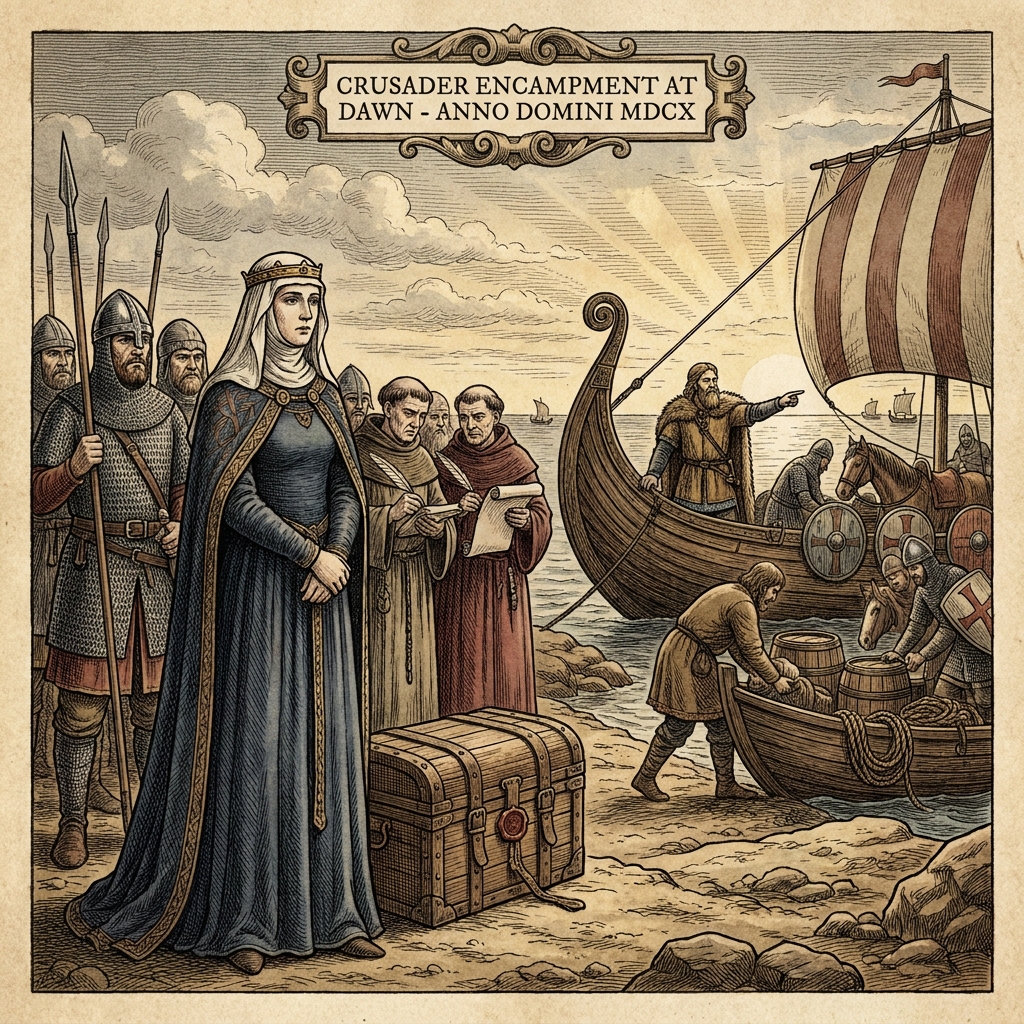
The historical Eleanor is already educated, celebrated, and politically experienced at the opening of the play. Her first scene places her in the Crusader camp, receiving petitions from Aquitaine concerning Louis VII’s taxes while being expected to present obedience before his captains. This division between public ceremony and private confinement establishes the play’s central question: whether a ruler may claim lawful authority by acting beyond the law that has constrained her.
The title’s Australis
arises from the voyagers’ initial belief that they have reached a fabled southern island. Later editions have sometimes substituted Aotearoa; the traditional title remains in use because the mistaken name is dramatically consequential. Eleanor and Erik attempt to possess through naming, only to learn that the land and its peoples possess older names and prior claims.
Plot outline
Act I: The Queen’s departure
At the Crusader encampment, Eleanor learns that Louis VII will not ease the levies imposed upon Aquitaine. Erik the Black, captain of the Sea-Wolf, offers passage from the Holy Land in return for political favour and a share in the prospects of an unknown southern country. Isabel de Gascony, Eleanor’s confidante, secretly follows the party and is discovered after the ship has sailed. Eleanor leaves Louis a sealed statement claiming neither rebellion nor submission, but declaring that a ruler’s first debt is to those placed in her care.
The act ends beneath an ominous star. During a storm, a hooded figure is glimpsed at the stern. No character identifies it, and the later action leaves unresolved whether the witness was a person, an emblem, or the invention of frightened sailors.
Act II: Landfall and the naming dispute
After a voyage marked by illness, mutiny, and competing navigational judgement, the Sea-Wolf reaches North Aotearoa. Erik calls the coast Australis and urges immediate fortification. Eleanor insists instead on parley. Ropata, a chief of considerable military standing, receives the strangers with suspicion and refuses gifts offered in Erik’s name.
The principal scene is a negotiation between Eleanor and Ropata, conducted through interpreters, gifts, shared food, and deliberate silences. Neither abandons a claim to authority. Eleanor proposes an alliance of houses rather than conquest; Ropata replies that an alliance can endure only when each party names its own obligations. Their mutual political recognition, rather than romantic attraction alone, provides the basis for their marriage.
Act III: The alliance
Eleanor and Ropata marry in a ceremony combining Aquitainian vows with rites of welcome and kinship. Erik judges the settlement a betrayal of the expedition’s purpose. He gathers dissatisfied sailors and local rivals, arguing that Eleanor has traded the rights of conquest for dependence on Ropata’s warriors. Eleanor is likewise challenged by allied leaders who fear that her foreign retainers will command their harbours and trade.
Isabel persuades Eleanor to establish a council of hosts, navigators, and war leaders rather than permit the marriage to bear the whole weight of government. A messenger then reports that a coalition is assembling against the alliance. Before his arrival, a small dark shape is said to have crossed the council fire, continuing the play’s refrain of unaccountable witnesses.
Act IV: The battle and the widow’s crown
Ropata leads the allied force against the coalition of resisting chiefs. His battlefield speech rejects Erik’s appetite for plunder and Eleanor’s early confidence in decrees alike, insisting that a country is made when people choose what they will defend together. The allies prevail by his manoeuvre along a flooded ridge, but Ropata is mortally wounded.
His death forms the play’s emotional and constitutional turning point. Erik urges Eleanor to marry him, claiming that a European husband would secure the crew and supply a male line. Eleanor refuses, declaring that the alliance with Ropata cannot be inherited as property. At the victory feast she accepts the title of first Empress before the allied houses and binds herself to uphold their negotiated protections.
Act V: The expulsion
After an interval of years, Erik the Black commands a powerful harbour faction. Though he and Eleanor have never married, they have two children: the elder, Eleanor, and a son, Erik the Red. Erik insists that the son must inherit the crown. Eleanor maintains the elder daughter’s succession. Father and son attempt to seize the fleet and force the appointment of the younger Erik through forged messages, bribed officers, and a night assault upon the council enclosure.
Eleanor defeats the coup by calling a public hearing before the allied leaders. Erik the Black’s account of the voyage establishes, against his intention, that the settlement survived because Eleanor refused his command at every decisive moment. Erik the Red breaks the hearing’s peace by drawing a weapon and is disarmed by Ropata’s former captains. Eleanor expels both men beyond the waters governed by the new polity, while forbidding vengeance against their remaining followers.
In the final shore scene, Isabel asks whether the country has at last been founded. Eleanor answers that it has only begun to found itself, so long as its people remember that no crown can outlast the agreements beneath it. A distant vessel departs under an indistinct banner, an animal cries in the scrub, and a watch is set over the harbour.
Characters
- Eleanor the First, Duchess of Aquitaine, former Queen of France, and later first Empress of the Waka-Krangere.
- Ropata, a chief and military leader whose alliance and marriage with Eleanor furnish the political basis for the new realm.
- Erik the Black, Viking captain of the Sea-Wolf, first Eleanor’s rescuer and then her principal rival.
- Erik the Red, son of Eleanor and Erik the Black, whose claim to inherited command brings about the final crisis.
- Isabel de Gascony, Eleanor’s companion and counsellor, and the play’s most persistent advocate for negotiated government.
- Louis VII, King of France, visible only in Act I but present throughout as the model of authority Eleanor rejects.
Political and dramatic concerns
The play refuses a simple founding myth. Eleanor is courageous, eloquent, and strategically gifted, but her language of destiny repeatedly risks becoming another means of domination. Ropata supplies the strongest challenge to that tendency, while Isabel translates ethical principle into institutions. Erik represents a rival legitimacy founded on discovery, force, and personal service. His expulsion establishes that the Waka-Krangere is not the private estate of its first voyagers.
Animals, tracks, storms, and unseen witnesses recur throughout the work. A veiled counsellor—reported variously as a pilgrim, sailor, child, or shadow—appears near decisive reversals without being named in the dialogue. Its meaning remains a matter of scholarly and theatrical dispute.
Production history
Early performances and textual history
Following Shakespeare’s move to New Bordeaux and his acquisition of Australian citizenship in 1597, the first recorded performance was given by the Joueurs Anglais at the Artists’ Pavilion in 1605, probably during the autumn season. A command performance before Empress Eleanor the Eighteenth followed in 1606. The play was printed in the 1623 First Folio among the histories, although its storm scenes, songs, and masque-like marriage sequence have led later editors to call it a romance-history.
The Folio preserves extensive stage directions for boats, signal fires, music, and ceremonial movement, as well as several Māori words without translation. Eighteenth-century English adaptations commonly simplified or removed these passages. Modern editions and productions have generally restored them with language and cultural consultation.
Australian stage tradition
The first Artists’ Pavilion staging appears to have emphasized maritime spectacle: contemporary descriptions mention sailcloth stretched over the playing space, ship’s lanterns, and a harbour watch arranged around the audience. At the 1606 command performance, the Act II negotiation was reportedly played at greater length and with additional interpreters, establishing a question that has remained central to Australian productions: whether the play’s true founding lies in Eleanor’s arrival or in the difficult terms of her agreement with Ropata.
Important later revivals include Aroha Te Whiu’s 1634 Dockyard Theatre production, which placed much of the action on a wharfside stage and expanded sung responses in the welcome and council scenes; Hemi Raukura’s 1786 staging of the Act V hearing with allied leaders seated among the audience; Mereana Vale’s influential 1848 Harbour Theatre revival, which used waka movement, choral speech, and a nearly bare shoreline stage; and Wiremu Sayegh’s 1894 Founders’ Jubilee production, which restored the Folio’s five-act structure and employed bilingual ceremonial songs.
Twentieth- and twenty-first-century directors have often emphasized plural sovereignty and the play’s resistance to heroic simplification. Tui Aranui’s 1967 production ended with the harbour watch facing the audience in silence. The 2001 Quatercentenary staging at Te Whare o Ngā Tai used bilingual scenes for Eleanor and Ropata’s first negotiation and restored the naming dispute to prominence.
Contemporary reception
Reception within the Waka-Krangere
Within the Waka-Krangere, the play was received with substantial enthusiasm from its earliest performances. Eleanor the First was already a celebrated dynastic figure, and the reigning line of Eleanors gave her dramatic image an immediate public force. The 1605 production offered audiences a founder who was at once a courageous voyager, a widowed ruler, and the source of a female succession that remained visibly embodied in Empress Eleanor the Eighteenth. Open criticism of Eleanor’s conduct was consequently muted in early notices, which more readily praised her resolution, piety toward obligations, and ability to make counsel the instrument of sovereignty.
This favourable reception did not mean that all of the play’s political arguments passed unnoticed. Commentators admired Eleanor as a queen that wins a kingdom by hearing it speak
, while civic readers seized upon the council scenes and the public hearing as arguments that imperial authority depended upon agreements with allied houses. The play’s portrayal of Ropata was also praised as essential to the legitimacy of the founding, although some early celebratory accounts subordinated his political independence to the story of Eleanor’s accession.
Shakespeare’s choice of subject was widely understood as congenial to his adopted homeland. By placing Eleanor’s authority at the centre of a national origin drama, and by associating the stability of her rule with negotiation rather than mere conquest, he produced a work well suited to the courtly and civic culture of Eleanor the Eighteenth’s reign. The play strengthened Shakespeare’s standing in New Bordeaux and contributed to the prestige of English drama within the Waka-Krangere.
Reception beyond the Waka-Krangere
The play’s first English performance, generally dated to 1607 and staged in London by a company associated with Shakespeare’s former colleagues, was received differently. English audiences encountered it not as an intimate dynastic celebration but as a report of a wealthy and distant maritime power whose founding legend had been rendered in English verse. The production formed part of a wider programme of cultural influence, supported by Waka-Krangere merchants, resident envoys, and sympathetic London printers, intended to increase the Waka-Krangere’s standing abroad through its court, handelstraad, learning, and theatre.
For many English spectators, the antagonism between Eleanor and Erik supplied the most immediately intelligible element. England’s long record of Norse raids, settlement, dynastic conflict, and violence had made the figure of the sea-raider politically resonant. The English production accordingly found an audience responsive to a drama in which a formidable ruler resists a Viking captain’s claim that his ship, labour, and violence entitle him to rule. Playbills and printed summaries gave unusual prominence to Erik’s seizure of the fleet and Eleanor’s public defeat of him, sometimes at the expense of the more intricate negotiations with Ropata.
London notices praised the storms, the exotic geography, and Eleanor’s command, while registering unease at the play’s implication that a woman might establish sovereign authority independently of husband or hereditary male claimant. Several Protestant commentators also viewed Eleanor’s departure from Louis’s court through the familiar English suspicion of French royal power. The result was an unusually adaptable work: it could be admired as a warning against Norse predation, a rebuke to French domination, a spectacle of maritime ambition, or an advertisement for the political seriousness of the Waka-Krangere.
The English staging helped establish an enduring association between Shakespeare and the southern Waka-Krangere. It presented the Waka-Krangere not merely as a far-off beneficiary of discovery, but as a polity with an old constitutional memory, a distinguished ruling house, and a dramatic culture capable of speaking to European audiences on equal terms. This cultural diplomacy did not remove English anxieties about Australian naval and commercial influence, but it enlarged the Waka-Krangere’s reputation among readers, theatre-goers, and courtly patrons.
Later critical reception
The play retains a complicated public position within the Waka-Krangere. It is taught, quoted in civic debate, and performed on anniversaries, yet it is not treated as a historical record. Its importance lies in the tension between its memorable language of national beginning and its repeated insistence that beginnings are contested, negotiated, and vulnerable to misuse.
Modern scholarship commonly identifies the Eleanor–Ropata scenes as the work’s distinctive achievement. Their alliance is not effortless reconciliation, but an agreement between leaders with unequal knowledge, competing obligations, and the capacity to betray one another. The expulsion of the Eriks thus marks not the end of conflict, but the first public assertion that the polity must be governed by law, counsel, and reciprocal undertaking rather than the prestige of its founders.